Subterranean termite control in Chattanooga requires a soil-level defense because eastern subterranean termites nest beneath ground frost lines and construct shelter tubes to reach structural floor joists. In…
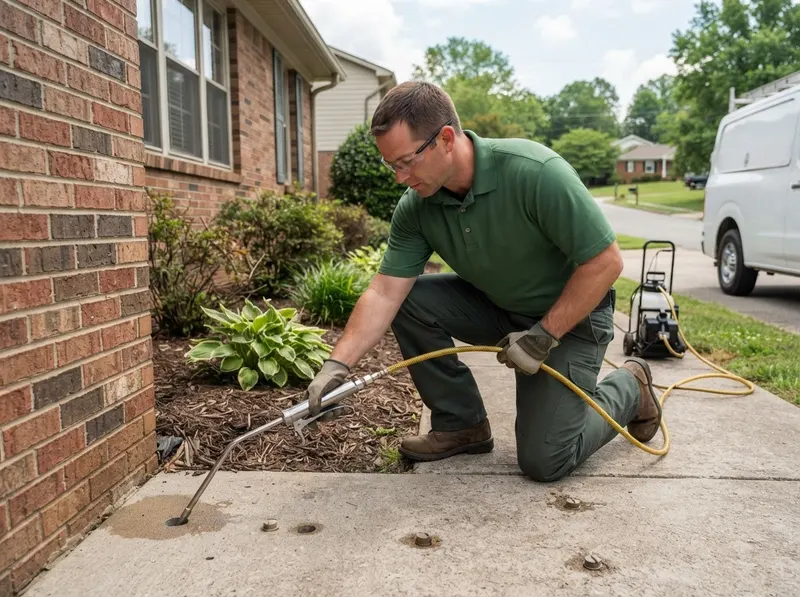
Subterranean termite control in Chattanooga requires a soil-level defense because eastern subterranean termites nest beneath ground frost lines and construct shelter tubes to reach structural floor joists. In neighborhoods like St. Elmo and Highland Park, historic homes constructed on stacked-stone piers or low brick crawlspaces place untreated sills directly adjacent to native red clay soils. Moisture retention along mountain slopes in Lookout Valley and limestone hollows near Red Bank accelerates subterranean colony expansion after damp springs, leaving floor systems compromised long before surface damage appears. Standard treatments rely on exterior soil trenching to saturate foundation perimeters with non-repellent termiticides, creating an undetectable lethal zone that foraging worker termites track back to reproductive queens. According to structural guidelines established by the Tennessee Department of Agriculture, non-repellent liquid soil barriers must remain continuous around all structural pillars, water lines, and crawlspace perimeter footers to prevent soil entry bypasses.
Selecting a protective treatment depends on the construction method of the structure. Monolithic concrete slab foundations common throughout Brainerd and East Ridge benefit from specialized perimeter trenching and rod injections, where technicians place liquid barriers without drilling interior finished floors unless active mud tubes originate through interior expansion joints. For historic properties in North Shore and Riverview with high crawlspaces, perimeter bait systems monitored according to EPA Integrated Pest Management standards provide continuous suppression without disturbing delicate ornamental landscape beds or vegetable plantings. Homeowners facing isolated mud tubes can deploy targeted localized injections starting at our $200 minimum fee, while complete structural envelope protections require full perimeter treatments. Homeowners seeking baseline biology on subterranean colonies can review research compiled by the University of Tennessee Extension, which details how annual swarming behaviors impact Hamilton County structures every March and April.
Subterranean termite management differs strictly from wood-boring beetle or drywood treatments, as subterranean species depend entirely on constant subterranean moisture access. For structures situated on sloping topography around Raccoon Mountain or the Southside Historic District, improper gutter drainage or soil backfill directly contacting structural wood sills breaks chemical barrier continuity. Property standards maintained by the U.S. Department of Housing and Urban Development require documented clearance between soil levels and wooden sills during real estate transfers. Professional technicians evaluate these structural interfaces, following structural guidance documented by the International Association of Certified Home Inspectors to separate biological termite damage from wet timber decay. Field applications align with safety classifications evaluated by the National Pesticide Information Center, ensuring barrier applications bind tightly to local soils rather than leaching into groundwater reservoirs or nearby residential runoff channels.
1. Technicians complete an exhaustive visual check of foundation walls, sill plates, crawlspaces, and pipe penetrations to map active mud tubes and moisture levels. 2. Field crews dig a continuous 6-inch by 6-inch trench directly against exterior foundation perimeters, exposing the underlying subsoil. 3. Technicians inject non-repellent termiticide liquid at calibrated volumetric rates per linear foot, backfilling the soil to seal the barrier. 4. Tamper-resistant monitoring stations are positioned in turf areas every 10 to 15 linear feet to intercept perimeter subterranean movements. 5. Technicians issue a detailed linear map recording treated zones, critical water clearances, and annual inspection checkpoints for long-term monitoring.
Every job gets a firm, written price after a free on-site visit.
Tell us about your subterranean termite control job in Chattanooga and we'll send a clear, written quote, usually the same day.
 WestHaven Pest Services