Remediating an attic or subfloor requires resolving both structural heat loss and ongoing biological hazards. In historic homes throughout St. Elmo and Highland Park, older crawl spaces often feature bare dirt floors…
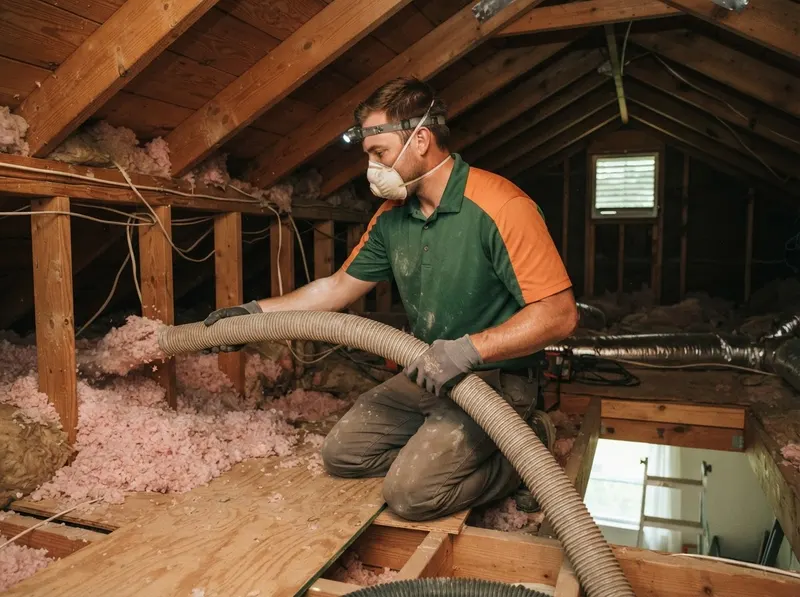
Remediating an attic or subfloor requires resolving both structural heat loss and ongoing biological hazards. In historic homes throughout St. Elmo and Highland Park, older crawl spaces often feature bare dirt floors where relative humidity regularly exceeds 70%, creating ideal harborages for wood-boring pests and rodents. Unsealed crawl spaces pull subfloor air up into primary living quarters through stack-effect convection. Technicians inspect floor joists, rim joists, and duct trunks using guidelines established by the U.S. Department of Energy, identifying chewed electrical lines, torn vapor membranes, and compacted batt insulation that has lost its rated thermal resistance.
Attic environments present unique contamination vectors, particularly along the humid ridge lines of Lookout Valley, Red Bank, and Brainerd. Rodents and bats leave biological waste that degrades air quality and violates ambient residential standards monitored by the Centers for Disease Control and Prevention. Rather than layering fresh insulation over contaminated material, technicians set up industrial negative-air HEPA extractors outside the living envelope to strip away urine-soaked rolls and rodent nests. Technicians then mist structural timber with EPA-registered antimicrobial agents to neutralize hantavirus, roundworm eggs, and fungal spores. Structural sealing follows, closing access points larger than one-quarter inch using wire mesh and expanding foam, conforming to EPA Integrated Pest Management principles.
Re-insulating the home brings building assemblies up to code according to the International Code Council commercial and residential energy conservation framework. For attic flats across North Shore and Riverview, blown-in borate-treated cellulose provides an R-38 to R-49 envelope. The borate additive acts as an integrated deterrent that kills self-grooming insects, including roaches and silverfish, while meeting Class A flame-spread ratings outlined by the National Fire Protection Association. In damp subfloors across Hixson and East Ridge, workers secure 10-mil to 20-mil polyethylene vapor retarders across 100% of the ground surface, staking seams with moisture-resistant tape as outlined by the International Association of Certified Home Inspectors.
Proper thermal installation balances air sealing with essential structural ventilation. Sealing attic soffits without adequate passive air movement can trap moisture, accelerating dry rot along structural rafters. Technicians calculate net free ventilating area according to ASTM International building standards, ensuring soffit and ridge vents stay unobstructed with custom-fit baffles. Technicians adhere strictly to OSHA confined-space safety regulations when operating in tight subfloors and elevated framing. Property managers can coordinate an on-site assessment through City of Chattanooga municipal boundaries by calling (803) 887-7497, receiving an exact, line-item price on-site following diagnostic measurements.
Every job gets a firm, written price after a free on-site visit.
Tell us about your crawl space and attic insulation services job in Chattanooga and we'll send a clear, written quote, usually the same day.
 WestHaven Pest Services